
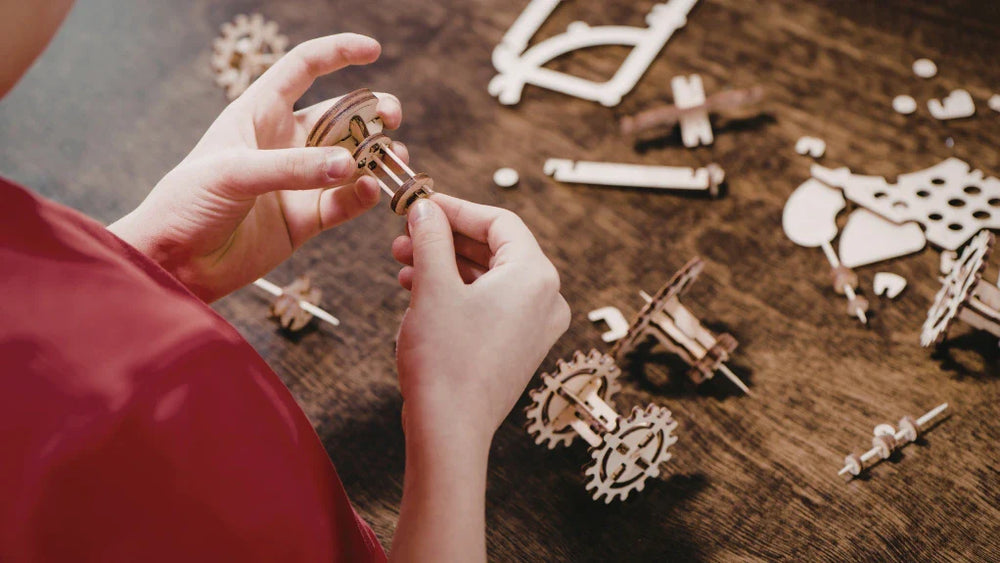
3D puzzles, which are intricate models that you assemble from various pieces, offer a unique twist on traditional puzzles. So, what is a 3D puzzle? They engage your creativity and challenge your problem-solving skills. The appeal of 3D puzzles lies in their ability to transform into stunning displays once completed.
Their popularity is on the rise, with adults making up 43% of the market. The 3D puzzle segment is projected to grow at a compound annual growth rate of 6.5% from 2026 to 2033. This trend shows that many people seek more sophisticated challenges.
Here are some statistics reflecting the puzzle market:
- Children: 57%
- Adults: 43%
- 3D puzzles: 12% of the overall puzzle market
With their unique features and engaging assembly process, 3D puzzles offer an experience unlike any traditional jigsaw puzzle.
Key Takeaways
- 3D puzzles enhance creativity and problem-solving skills, making them a rewarding challenge for all ages.
- Engaging with 3D puzzles improves spatial awareness and cognitive development, especially in children.
- These puzzles come in various types, including architectural, mechanical, and educational, catering to diverse interests.
- Assembling 3D puzzles promotes focus, patience, and stress relief, providing a satisfying hands-on experience.
- Choosing the right 3D puzzle involves considering age, skill level, and purpose, ensuring an enjoyable assembly experience.
What Is a 3D Puzzle?

Definition of a 3D Puzzle
A 3D puzzle is a three-dimensional construction kit that assembles into a free-standing structure. These puzzles differ significantly from traditional flat jigsaw puzzles. Here’s a quick overview of their defining features:
| Feature | Description |
|---|---|
| Definition | A 3D puzzle is a three-dimensional construction kit that assembles into a free-standing structure. |
| Materials | Made from interlocking foam, plastic, or wood, offering structural integrity beyond standard cardboard. |
| Assembly Experience | Involves matching shapes and structural components to build a physical object, differing from flat jigsaw puzzles. |
| Engineering | Utilizes specialized die-cut technology for secure interlocking pieces without glue or tools. |
| Uniqueness of Pieces | Pieces are varied in shape to accommodate structural needs, ensuring a smoother assembly process. |
How 3D Puzzles Work
To understand how 3D puzzles work, you must explore their core mechanics. Mechanics is a crucial area of physics that explains how different parts interact during movement. This understanding is vital for grasping how you assemble these puzzles.
When you start assembling a 3D puzzle, you engage with various mechanical principles. For example, beginner kits often teach foundational concepts like gear meshing and axle rotation transfer. These concepts help you create motion through simple linkages. As you progress to more complex models, you will encounter functional designs that incorporate moving parts and gears. This integration of engineering principles with artistic design makes 3D puzzles not only challenging but also rewarding.
By assembling a 3D puzzle, you gain hands-on experience with real-world systems. You learn how different components work together to create a cohesive structure. This practical knowledge enhances your problem-solving skills and deepens your understanding of mechanics.
Common Types of 3D Puzzles
Architectural 3D Puzzles
Architectural 3D puzzles allow you to recreate famous landmarks and historical structures. These puzzles often feature intricate designs that challenge your attention to detail. You might find models of iconic buildings like the Eiffel Tower or the Taj Mahal. As you assemble these structures, you gain insight into architectural styles and construction techniques.
Mechanical and Moving 3D Puzzles
Mechanical and moving 3D puzzles add an exciting twist to the assembly experience. Here are some notable examples:
- Rubik's Cube: A classic puzzle that requires you to twist and turn to align colors on each face.
- Cryptex: This puzzle involves a combination lock mechanism, challenging you to figure out the correct sequence to open it.
- 4D Cityscape Puzzles: These allow you to build a city layer by layer, representing different time periods.
- 4D Solar System Puzzles: These include rotating planets that mimic real-world orbits once assembled.
These puzzles not only test your problem-solving skills but also introduce you to basic mechanical principles.
Educational 3D Puzzles
Educational 3D puzzles enhance learning outcomes by providing an engaging way to understand complex concepts. For instance, the 3D foot and ankle puzzle helps students grasp anatomical structures. The tactile nature of these puzzles allows you to physically interact with the material, improving retention of knowledge. Gamification in these puzzles makes learning enjoyable and motivates you to engage with the subject matter.
Artistic and Decorative 3D Puzzles
Artistic and decorative 3D puzzles showcase creativity and craftsmanship. Common themes include:
- Mechanical models: Feature moving gears and intricate mechanisms.
- Vehicles and sci-fi: Include classic cars, ships, and futuristic models.
- Nature and fantasy: Showcase insects, animals, and mythical creatures.
These puzzles not only serve as fun projects but also as beautiful displays once completed.
Materials Used in 3D Puzzles
Wooden 3D Puzzles

Wooden 3D puzzles offer a unique tactile experience. They are durable and often feature beautiful aesthetics. Here are some advantages and disadvantages of wooden puzzles:
| Advantages of Wooden 3D Puzzles | Disadvantages of Wooden 3D Puzzles |
|---|---|
| Improve spatial reasoning skills | Time-consuming to complete |
| Sense of accomplishment | Requires more space |
| Durable and long-lasting | Generally more expensive |
| Unique shapes for added enjoyment | Limited availability in stores |
You will find that 3D wooden puzzles often provide a satisfying challenge. Their solid construction makes them a favorite among puzzle enthusiasts.
Cardboard and Paper-Based Puzzles
Cardboard and paper-based 3D puzzles are popular for their affordability and lightweight nature. However, they come with some drawbacks. Here are some key points to consider:
- Cardboard used in puzzles may not be sourced sustainably, leading to deforestation.
- Chemical treatments on paper can involve toxic dyes, which are not biodegradable.
- Plastic packaging contributes to landfill waste and ocean pollution.
Despite these concerns, you can find ways to make cardboard puzzles more eco-friendly. Consider switching to recycled or FSC-certified cardboard and using soy-based inks that are biodegradable.
Plastic and Composite Materials
Plastic 3D puzzles are budget-friendly and resistant to wear and tear. They are easy to assemble, making them suitable for beginners. However, they may lack the premium feel of wooden puzzles. Here’s a quick overview of the pros and cons:
| Material Type | Pros | Cons |
|---|---|---|
| 3D Paper/Cardboard Puzzle | Cheap, Lightweight | Flimsy, Fragile pieces make assembly challenging, Not as popular |
| 3D Wooden Puzzle | More durable, Naturally beautiful aesthetics, Precise cuts | Solid wood can be heavy, Can be expensive depending on the wood used |
| 3D Plastic Puzzle | Resistant to wear and tear, Budget-friendly, Easy assembly | Less premium compared to other materials, Not eco-friendly |
| 3D Metal Puzzle | Robust and corrosion-resistant, Luxurious aesthetics | Not for children and beginners, More expensive, Can have sharp edges |
Benefits of 3D Puzzles
Improving Spatial Thinking Skills
Engaging with 3D puzzles significantly enhances your spatial thinking skills. Research shows that puzzle play can improve cognitive development in young children. For example, a study by Mulyana et al. (2022) found that preschoolers who engaged in puzzle activities scored higher in cognitive assessments compared to those who participated in regular activities. Here’s a summary of key findings from various studies:
| Study | Findings |
|---|---|
| Mulyana et al. (2022) | Puzzle play significantly improved cognitive development scores in preschoolers aged 4-6 compared to regular activities. |
| Verdine et al. (2014) | Engagement with puzzles linked to improved spatial skills and early math readiness. |
| Zhang et al. (2020) | Preschoolers with better spatial skills built more complex block structures, indicating a link between spatial ability and construction complexity. |
| Yang et al. (2020) | Meta-analysis showed strong gains in spatial skills from early childhood interventions involving 2D spatial tasks. |
| Schmitt et al. (2018) | Structured block-play curriculum improved preschool children's mathematics and executive functioning. |
Enhancing Focus and Patience
Assembling 3D puzzles requires a high level of focus and patience. Engaging with these puzzles activates your entire brain, leading to improved cognitive functions. You may notice that you become more present and empathetic during the assembly process. Families often comment on their greater patience and problem-solving skills after working on puzzles together. This engagement sharpens critical cognitive skills and translates to improved patience in everyday situations.
Stress Relief and Relaxation
Working on 3D puzzles can provide significant stress relief and relaxation. The tactile experience of sorting pieces and assembling them can induce a meditative state. Research indicates that this activity can reduce cortisol levels by 19%. Each step in the assembly process offers immediate feedback, creating a sense of reward that enhances focus and relaxation. Engaging with a Book Nook Kit 3D wooden puzzle allows for creative expression, promoting relaxation and stress reduction.
Educational Value for All Ages
3D puzzles offer educational value across different age groups. They enhance cognitive development by improving memory and concentration in children. For toddlers, puzzles foster manual dexterity and problem-solving skills. School-aged children benefit from reinforcing academic concepts, while teenagers sharpen their logical reasoning. Here are some benefits of 3D puzzles for various age groups:
- Toddlers (18 months - 5 years): Cognitive development, manual dexterity, and problem-solving skills.
- School-Aged Children (6 - 12 years): Academic reinforcement, social skills, and emotional development.
- Teenagers (13 - 18 years): Advanced cognitive skills, educational advantages in STEM, and stress relief.
3D puzzles serve as excellent educational tools, making learning engaging and fun.
3D Puzzles vs. Traditional Jigsaw Puzzles
Difficulty and Learning Curve
When comparing 3D puzzles to traditional jigsaw puzzles, you will notice significant differences in difficulty and the learning curve. The skills required for each type vary greatly. For instance, a standard 2D puzzle primarily focuses on pattern and color recognition. In contrast, a 3D jigsaw puzzle emphasizes spatial awareness and structural logic.
Here’s a quick comparison:
| Feature | Standard 2D Puzzle | 3D Jigsaw Puzzle |
|---|---|---|
| Primary Skill | Pattern and color recognition | Spatial awareness and structural logic |
| Workspace | Requires a large, flat table | Requires less table space, but vertical clearance |
| Piece Sorting | Sorted by edge vs. center and color | Sorted by structural section (e.g., base, walls, roof) |
| Stability | Stable on the table | Can be fragile during construction |
| End Result | A flat image (usually framed) | A display model or decoration |
Time Investment
The time you invest in assembling a 3D jigsaw puzzle can differ from that of a traditional puzzle. Generally, 3D puzzles require more time due to their complexity. You must consider the structural integrity of each piece and how they fit together. This added challenge can lead to a more rewarding experience, as you see your efforts come to life in three dimensions.
Display and Reusability
Once you complete a 3D puzzle, you have several options for displaying or preserving your work. Here are some popular methods:
- Framing: Finished puzzles can be framed and hung on walls, making them a decorative piece of art.
- Sticky Paper: Applying sticky paper to the back of the puzzle helps keep it intact for framing.
- Glue Application: Using a clear-drying glue to secure the pieces is a common method for preservation.
- DIY Framing: If the puzzle can withstand the 'lift test', it can be placed directly into a frame without additional glue or tape.
- Float Mounting: This technique allows the puzzle to appear as if it is floating within the frame, showcasing its edges and depth.
These options enhance the enjoyment of your 3D puzzles, allowing you to showcase your creativity and hard work.
Who Are 3D Puzzles For?
Kids and Teenagers
3D puzzles are perfect for kids and teenagers. They provide a fun way to develop critical thinking and spatial skills. A study by Mulyana and colleagues found that puzzle play significantly improved cognitive development scores in children aged 4-6 years compared to regular classroom activities. Engaging with these puzzles helps young minds enhance their problem-solving abilities.
Benefits for Kids:
- Boosts cognitive skills.
- Encourages creativity and imagination.
- Fosters teamwork and patience during group activities.
Adults and Hobbyists
Adults and hobbyists also find joy in 3D puzzles. These puzzles serve as a relaxing hobby that challenges your mind. They allow you to escape daily stress while engaging in a rewarding activity. Many adults enjoy assembling intricate models, which can become stunning displays in their homes.
Why Adults Love 3D Puzzles:
- They provide a sense of accomplishment.
- They enhance focus and patience.
- They offer a creative outlet for artistic expression.
Educators and Parents
Educators and parents can incorporate 3D puzzles into learning and play activities. These puzzles enhance critical thinking and problem-solving skills, essential for understanding complex lessons. In English classes, word games and logic puzzles help students engage with language in a multifaceted way.
Ways to Use 3D Puzzles in Education:
- Use puzzles in math lessons to encourage reasoning.
- Incorporate puzzles in science lessons to promote critical thinking.
- Foster teamwork and listening skills through collaborative puzzle-solving.
By integrating 3D puzzles into various settings, you can create an enriching experience for learners of all ages.
How to Choose the Right 3D Puzzle
Age and Skill Level
When selecting a 3D puzzle, consider your age and skill level. Choose a puzzle that excites you, whether it features dinosaurs, vintage cars, or mechanical clocks. Assess your experience honestly to avoid frustration. Start with manageable puzzles if you are a beginner. Look for puzzles with clear difficulty ratings based on piece count and complexity.
- Piece Count: Ranges from 15 pieces for beginners to over 1,200 for experts.
- Complexity of Design: Consider whether the design is straightforward or intricate, as this affects the challenge.
- Quality of Materials: Opt for puzzles made from high-quality, eco-friendly materials for a better building experience.
Puzzle Size and Piece Count
Puzzle size and piece count significantly affect the complexity and enjoyment of 3D puzzles. Smaller puzzles with fewer than 100 pieces are easier and ideal for beginners. Larger puzzles with more pieces present a greater challenge and require more time and patience.
- Difficulty Ratings: Modern 3D wooden puzzles consider both piece count and overall complexity.
- Complexity Increases: The number of pieces increases the complexity, making the final product more detailed and intricate. A 200-piece mechanical model may be more challenging than a 300-piece static model.
Purpose: Fun, Learning, or Display
Understanding your purpose for assembling a 3D puzzle can guide your choice. Many people find assembling 3D puzzles enjoyable, as indicated by positive feedback during events.
- Fun: Assembling puzzles can be a fun activity that brings joy and satisfaction.
- Learning: 3D puzzles improve anatomical and spatial knowledge, making them excellent educational tools.
- Display: Many choose puzzles for their aesthetic appeal, creating beautiful displays once completed.
By considering these factors, you can select a 3D puzzle that aligns with your interests and goals, ensuring a rewarding experience.
3D Puzzles as a Way to Understand Real-World Systems
Learning Engineering Logic Through Assembly
As you assemble 3D puzzles, you engage in a process that mirrors engineering logic. This hands-on activity requires you to think several steps ahead. You analyze patterns and test theories before making a move. Such mental tasks not only enhance your spatial reasoning but also improve problem-solving skills. Engaging in these complex activities can help maintain memory function and may even delay cognitive decline.
3D Puzzles as a “Hands-On Simulation”
3D puzzles serve as effective hands-on simulations for various real-world systems. Here are some examples of how they apply in different fields:
| Field | Example Use | Outcomes |
|---|---|---|
| Educational Tools | 3D puzzles for teaching geometry, engineering, and physics. | Improved spatial reasoning and problem-solving skills, higher test scores in STEM subjects. |
| Industrial Design & Prototyping | Prototyping components and assemblies in automotive and aerospace industries. | Reduced development time, fewer errors, and cost savings. |
| Therapeutic Applications | Cognitive rehabilitation and motor skills development in healthcare. | Significant improvements in patient outcomes, increased independence and confidence. |
| Architectural Visualization | Visualizing building designs and planning construction sequences. | Improved collaboration, faster decision-making, and reduced costly errors. |
Why This Matters in a Digital-Only World
In today's digital-only world, hands-on learning with 3D puzzles becomes increasingly important. Engaging with these puzzles promotes active participation, which is crucial in a landscape dominated by screens. The tactile experience of handling physical pieces enhances your understanding and retention of complex concepts.
Working with 3D puzzles also develops fine motor skills and cognitive health, essential for overall learning and development. This method enables you to grasp spatial relationships without relying solely on memorization, enhancing comprehension in educational contexts.
3D puzzles offer a unique blend of creativity, education, and fun. They enhance spatial awareness, improve problem-solving skills, and foster collaboration. Here’s a summary of their unique features and benefits:
| Type of Puzzle | Unique Features and Benefits |
|---|---|
| Mechanical Puzzles | Involve intricate mechanisms and require precise assembly for functionality. |
| Architectural Puzzles | Replicate famous structures, enhancing spatial awareness and attention to detail. |
| Artistic and Customizable Puzzles | Allow for personal expression and creativity through customization. |
| Educational and Interactive Puzzles | Combine learning with hands-on construction, making subjects engaging and interactive. |
If you're new to 3D puzzles, start with easier ones, ideally those with less than 100 pieces. Choose themes that excite you and organize pieces by color or shape for a smoother assembly experience. Dive into the world of 3D puzzles for a rewarding challenge! 🎉
FAQ
What are the benefits of solving a 3D puzzle?
Solving a 3D puzzle improves spatial reasoning, enhances focus, and promotes patience. You also gain stress relief and enjoy a sense of accomplishment upon completion.
How long does it take to complete a 3D puzzle?
The time to complete a 3D puzzle varies based on complexity and piece count. Simple puzzles may take a few hours, while intricate designs can take several days.
Are 3D puzzles suitable for all ages?
Yes, 3D puzzles cater to various age groups. They offer educational benefits for children and enjoyable challenges for adults, making them great for family activities.
Can I display my completed 3D puzzle?
Absolutely! You can frame your completed 3D puzzle or use adhesive to preserve it. Many people display their puzzles as decorative art pieces in their homes.
Where can I buy 3D puzzles?
You can find 3D puzzles at toy stores, online retailers, and specialty puzzle shops. Look for reputable brands to ensure quality and durability.